From Hurghada: The Mediterranean Youth Foundation Addresses Climate Change! The Mediterranean Youth Foundation, in collaboration with the Egyptian Ministry of Youth and Sports, is preparing to launch the second edition of our regional project, the Mediterranean Initiative for Climate, from December 19 to 23, 2024. The importance of the initiative stems from its response to the growing environmental challenges in the Mediterranean region, which accommodate more than 510 million people, and where temperatures are rising 20% faster than the global average, according to United Nations reports. This initiative aims to build capacities, develop environmental policies, and generate knowledge to raise awareness about climate change. It serves as a platform for interaction and cultural exchange among Mediterranean youth to innovate environmental solutions and address shared challenges. Stay tuned for event details and share your expectations with us!

“Ministry of Youth and Sports and Mediterranean Youth Foundation Continue to Address Climate Change” The Mediterranean Youth Foundation and the Ministry of Youth and Sports are continuing the activities of the second edition of the regional project “Mediterranean Initiative for Climate” from December 19 to 23, 2024. The initiative included a variety of sessions, ranging from workshops and listening sessions to research activities and presentations focusing on Gender Lens on Climate Change. These sessions were led by Dr. Yasmeen Aladdin, a gender expert and co-president of the Mediterranean Youth Foundation. The initiative also featured artistic performances by participants that addressed concepts such as loss and damage, mitigation and adaptation, and deep decarbonization, reflecting the initiative’s aim to translate climate action to the grassroots level. The importance of this initiative lies in responding to the increasing environmental challenges in the Mediterranean region, which accommodate more than 510 million people, where temperatures are rising 20% faster than the global average, according to UN Environment reports. Our journey in Hurghada for climate change has come to an end, but our efforts continue. Stay tuned for more updates!

The Mediterranean Youth Foundation, in collaboration with the Ministry of Youth and Sports, is organizing the second edition of the regional project, “The Mediterranean Initiative for Climate,” from December 19 to 23, 2024. This initiative aims to build the capacities of representatives of youth organizations and entities, develop environmental policies, and generate knowledge to raise awareness about climate change. It also seeks to explore the regional interaction mechanism between science and policies as recognized by the Barcelona Convention. The initiative includes diverse sessions such as workshops, hearings, research activities, and presentations on the conceptual framework and historical background of climate change, along with key related international agreements. It also featured a knowledge competition on climate and environmental terminology presented by Mr. Youssef Aroog. Additionally, the initiative hosted a session on climate diplomacy and translating climate action to the grassroots level, including mechanisms for negotiation between parties, presented by Mr. Mohamed Ageez, Climate Action Advisor at the Mediterranean Youth Foundation and Managing Partner at TIS Labs. The importance of this initiative lies in responding to the increasing environmental challenges in the Mediterranean region, which accommodate more than 510 million people, where temperatures are rising 20% faster than the global average, according to UN Environment reports. Our activities are still ongoing… Stay tuned! #Youth #peace #Youth4Mediterranean #MYF

Before the next United Nations (UN) Climate Change Conference 2022 (UNFCCC, COP 27) that will take place in Egypt in November 2022, the Mediterranean Youth Foundation for Development (MYF,) hosted  in cooperation with the “Oceans Network” through the Erasmus+ student and Alumni Alliance (ESAA EU,) funded by the “European Commission” with the support of the Egyptian Ministry of Youth and Sports and the Egyptian Ministry of Environment, brought together 55 youth aged 21-35 from the Euro-Mediterranean countries for a 3-day training covering the topic of climate change, in August 2022 in El- Alamein, Egypt.

How It Worked?

The aim of the initiative was to raise awareness about climate change and building the capabilities of youth in the field of climate change. In addition to the training, awareness raising campaigns and contests that have been organized on the same topic, engaging as many youths as possible with the priority topics of the upcoming COP27 (unemployment, The climate crisis, migration, gender inequality) and building the capacities of young men and women to face these challenges.

In a multicultural atmosphere, the Mediterranean Initiative for Climate was launched, with participation of 55 participants from different Mediterranean countries from Spain, Lebanon, Palestine, Bosnia and Herzegovina and Egypt which included about 10 workshops and panel discussions with approximately 50 training hours, and addressed a number of main topics of concern to everyone interested in the environment and climate change, namely environmental peace, challenges of the environment in the Mediterranean and mechanisms of mitigation and adaptation.

The workshops also dealt with how to write a policy paper specialized in the environment, and at the end of the program, the participants worked on writing and submitting policy papers, which will be evaluated and reviewed, to be presented to the officials.

How was social media used?

Before the workshops started, the Mediterranean Youth Foundation launched an online awareness campaign to educate the audience about the issue of climate change, the dangers of using plastic, and how they can contribute to reducing the effects of climate change by publishing a set of posters and infographics.

Also, two competitions were launched. The first was a question competition, the winners received a set of prizes, from an opportunity to participate in the workshops to financial prizes and certificates of appreciation, and the second competition was an article competition, where the participants worked on writing articles on the issue of climate change in Arabic and English. A team of professionals assessed them, and the essay competition winners were allowed to participate in the workshops and receive monetary prizes.

Outcomes 

We are at a critical moment in human history. We are facing a dangerous issue that needs individuals, communities, local, regional and global organizations and governments to come together to reduce the effects of climate change. In November 2022, world leaders will gather at the United Nations Climate Change Conference, an important event in our journey to tackle climate change. We came out of the Mediterranean Initiative for Climate with a set of recommendations, which are as follows:

  1. The necessity of activating and accelerating climate policies worldwide and involving youth in a greater way in limiting the effects of climate change.
  2. Climate action cannot be postponed for the next decade, next year, or tomorrow. We all have to take action now.
  3. There is an urgent need to view the environment as an essential human right.
  4. Governments and local, regional, and international organizations need to strengthen the channels of communication between them, and governments should strengthen the channels of participation at the national and international levels in all stages of planning, implementation, evaluation, and monitoring of climate action policies and programs.

In the end, it can be said that this initiative was an excellent opportunity to pave the way for the Climate Summit, as it was necessary to involve a group of young people from all over the world to exchange views, experiences, and cultures, to come up with a set of policies that can be presented to governments to reduce the effects of climate change.

*A Funded Opportunity for Those Interested in Climate Action in Egypt – The Mediterranean Initiative for Climate MIC*.

Are you a climate action activist?
Do you have an idea or a recommendation in the field of climate and you need a financial or technical support?
Are you between 18 and 35 years old?
If your answers are yes, then this is your opportunity to be part of the change.

Apply now for the 4th edition of the Mediterranean Initiative for Climate (MIC) and receive free training and a chance to obtain a financial support up to 500 USD.

The project is implemented by the Mediterranean Youth Foundation (MYF) under the patronage of the Egyptian Ministry of Environment and in cooperation with Misr El-Kheir Foundation and Population Matters. The 4th edition focuses on three key pillars:

Building youth capacity, enhancing climate knowledge, and understanding international efforts and the outcomes of climate summits.
Empowering youth through field environmental initiatives and providing direct financial support.
Supporting their participation in decision-making by training them on how to prepare policy papers and provide badges to attend official climate negotiations.

Benefits of participation:

Receive free training on climate change, its historical background, and international efforts.
The possibility of obtaining micro-technical and financial support up to 500 USD to fund environmental initiatives and projects.
Participate in the preparation of policy papers with the possibility of obtaining badges to attend official climate negotiations such as COP-SB.

Note: This project is funded, and there are no fees for participation.

The final deadline for registration is December 20, 2025, at 11PM Cairo Time.

The third edition of the Mediterranean Initiative for Climate (MIC) is being launched from Ras El Bar, Egypt. In parallel with the Local Conference of Youth (LCOY Egypt 2025), the Mediterranean Youth Foundation and its partners launched the third edition of our strategic project, the “Mediterranean Initiative for Climate.” The initiative is jointly supported by the Council of Europe and the European Union and is being implemented in Egypt by the Mediterranean Youth Foundation, under the joint patronage of the Ministry of Youth and Sports and the Ministry of Environment. The events kicked off with ice-breaking sessions and energizing activities, followed by interactive workshops addressing key climate change questions: What is it? When did it start? How was the response of the international community? What is the role of cultural dialogue in fostering Euro-Mediterranean cooperation? This initiative comes as part of the foundation’s plan to develop the skills and build the capacities of civil society actors, aiming for sustainable development driven by youth leadership. Aroog also facilitated an analytical session that explored the evolution of international frameworks to combat climate change , starting from the United Nations Framework Convention on Climate Change (UNFCCC), followed by the Kyoto Protocol, and then the Paris Agreement, all the way up to the long-term European Green Deal, which aims to make the EU the first climate-neutral continent by achieving net-zero emissions by 2050! A rich sequence that reflects how the international community’s response to the climate issue has evolved, and highlights the importance of continued cross-border cooperation for a more sustainable future. Stay tuned for upcoming events and reports.

Digitalization and Sustainability: Towards More Efficient Data Collection in Egyptian Airports

For Arabic, see below – للغة العربية، يرجي الإطلاع في الأسفل

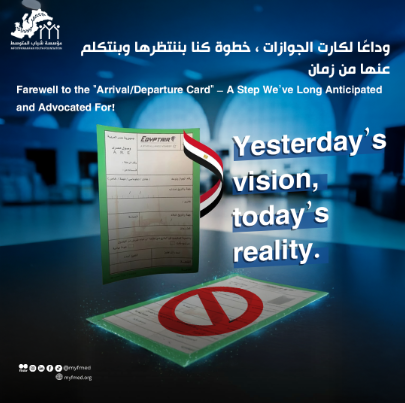
The Mediterranean Youth Foundation for Development – MYF strongly urges the Egyptian government and the competent authorities to replace the current paper-based data collection form with a more sustainable digital solution in Egyptian airports. 

Currently, the use of the Immigration or Landing paper form to collect passengers’ personal information upon arrival at Egyptian airports is ineffective. Lisa, an Italian traveler who arrived in Egypt on August 21st, recounted her experience at the airport as frustrating and inefficient. Upon arrival, she was required to fill out the paper form with her personal information, only to see it discarded at the document control without any apparent use. The lack of available pens added to the difficulties, especially for foreigners like herself who also had to navigate language barriers. Filling out the form took approximately 3 to 5 minutes, during which time the area around the checkpoints became increasingly crowded, leading to longer queues. 

Given the reported data from Egypt’s Ministry of Civil Aviation for 2023, this issue becomes even more significant. The ministry reported a total of 47 million passengers, an increase of 28% year-on-year. Specifically, Cairo International Airport saw 26 million passengers, Hurghada International Airport handled 8.7 million, Sharm El-Sheikh International Airport had 5.9 million, and Alexandria Borg El Arab Airport processed 2 million passengers​​. With these growing numbers, the inefficiency of the current system is exacerbated, highlighting the urgent need for a more sustainable and efficient data collection method. 

In an era where digital technology is transforming the way we live and work, airports worldwide are moving towards more modern and efficient solutions to manage the growing flow of passengers. With an increasing number of passengers, Egyptian airports have the opportunity to adopt innovative digital solutions to enhance their capacity, streamline operations, and provide a smoother and faster process, thereby reducing inconveniences and frustrations for an improved overall experience.

Recognizing this potential, the Mediterranean Youth Foundation for Development (MYF) strongly advocates for the adoption of a digital data collection system at Egyptian airports. Transitioning to a digital system would eliminate the use of paper forms, reducing workload and costs for airports while speeding up information processing. This shift not only streamlines daily operations but also ensures immediate and secure access to data, enhancing the ability to analyze and respond to passenger needs effectively.

This transition is crucial for advancing environmental sustainability. Moving from paper-based systems to digital solutions represents a significant step towards reducing waste and carbon emissions. Paper production involves the use of natural resources and greenhouse gas emissions, while managing and disposing of paper documents adds further environmental impacts. By adopting digital systems, airports can mitigate these impacts, contributing to a more eco-friendly environment and aligning with modern sustainability practices.

Moreover, a digital data collection system offers substantial social benefits. It enhances inclusion and accessibility for all travelers. A digital system can support multiple languages and facilitate communication for non-local travelers. This improves the overall experience, reduces language barriers, and ensures a smoother, more inclusive journey for every passenger. 

Transitioning to a digital data collection system in Egyptian airports is not just a technological upgrade but a necessary step toward a sustainable future. By embracing digital solutions, Egyptian airports can significantly enhance their operational efficiency, reduce environmental impact, and improve the overall passenger experience. This transition aligns with global trends in airport management ensuring that Egypt’s airports are well-equipped to meet the demands of an ever-growing number of travelers while promoting environmental and social responsibility. 

الرقمنة والاستدامة: نحو طريقة جمع بيانات أكثر كفاءة في المطارات المصرية

تدعو مؤسسة شباب المتوسط للتنمية بشدة الحكومة المصرية والسلطات المختصة إلى استبدال نموذج جمع البيانات الورقي الحالي بحل رقمي أكثر استدامة في المطارات المصرية.
في الوقت الحالي ، يعد استخدام نموذج بطاقة الوصول أو بطاقة الهجرة لجمع المعلومات الشخصية للمسافرين/ات عند الوصول إلى المطارات المصرية غير فعال. روت ليزا ، وهي مسافرة إيطالية وصلت إلى مصر في 21 أغسطس، تجربتها في المطار باعتبارها محبطة وغير فعالة. عند الوصول ، كان مطلوبًا منها ملء البطاقة الورقية بمعلومات شخصية، فقط لرؤيتها يتم التخلص منه في مراقبة الوثائق دون أي استخدام واضح. أضافت عدم توفر الأقلام إلى الصعوبات، خاصة بالنسبة للأجانب مثلها الذين اضطروا أيضًا إلى التنقل بين الحواجز اللغوية. استغرق ملء النموذج من 3 إلى 5 دقائق تقريبًا ، وخلال هذا الوقت ، أصبحت المنطقة المحيطة بنقاط التفتيش أكثر ازدحامًا ، مما أدى إلى طوابير أطول.
مع البيانات المبلغ عنها من وزارة الطيران المدني المصرية لعام 2023 ، تصبح هذه المشكلة أكثر أهمية. أفادت الوزارة بإجمالي 47 مليون مسافر/ة ، بزيادة قدرها 28٪ على أساس سنوي. على وجه التحديد، شهد مطار القاهرة الدولي 26 مليون مسافر/ة، وتعامل مطار الغردقة الدولي مع 8.7 مليون، ومطار شرم الشيخ الدولي مع 5.9 مليون، بينما تعامل مطار الإسكندرية برج العرب مع مليونين من المسافرين/ات. مع هذه الأعداد المتزايدة، يزداد عدم كفاءة النظام الحالي سوءًا، مما يسلط الضوء على الحاجة الملحة إلى طريقة جمع بيانات أكثر استدامة وكفاءة.
في عصر تحول التكنولوجيا الرقمية الطريقة التي نعيش ونعمل بها ، تتحرك المطارات في جميع أنحاء العالم نحو حلول أكثر حداثة وكفاءة لإدارة التدفق المتزايد للمسافرين/ات. مع زيادة عدد المسافرين/ات، تتمتع المطارات المصرية بفرصة اعتماد حلول رقمية مبتكرة لتعزيز قدرتها و تبسيط العمليات و توفير عملية أكثر سلاسة وأسرع ، مما يقلل من الإزعاج والإحباط لتحسين التجربة العامة.
اعترافًا بهذا الإمكانات ، تدعو مؤسسة شباب المتوسط للتنمية بشدة إلى اعتماد نظام رقمي لجمع البيانات في المطارات المصرية. من شأن الانتقال إلى نظام رقمي القضاء على استخدام البطاقات الورقية، مما يقلل من عبء العمل والتكاليف على المطارات مع تسريع معالجة المعلومات. لا يقتصر هذا التحول على تبسيط العمليات اليومية فحسب، بل يضمن أيضًا الوصول الفوري والآمن إلى البيانات، مما يعزز القدرة على تحليل احتياجات المسافرين/ات والاستجابة لها بفعالية.
يعد هذا الانتقال ضروريًا للنهوض بالاستدامة البيئية. يمثل الانتقال من الأنظمة الورقية إلى الحلول الرقمية خطوة كبيرة نحو تقليل النفايات وانبعاثات الكربون. ينطوي إنتاج الورق على استخدام الموارد الطبيعية وانبعاثات غازات الاحتباس الحراري، بينما تضيف إدارة وتخلص من الوثائق الورقية تأثيرات بيئية إضافية. من خلال اعتماد الأنظمة الرقمية، يمكن للمطارات تخفيف هذه التأثيرات، مما يساهم في بيئة أكثر مراعاة للبيئة والتماشي مع ممارسات الاستدامة الحديثة.
علاوة على ذلك، يقدم نظام جمع البيانات الرقمي فوائد اجتماعية كبيرة. إنه يعزز الشمولية والوصول إلى جميع المسافرين. يمكن للنظام الرقمي دعم لغات متعددة وتسهيل التواصل للمسافرين/ات غير المحليين/ات. هذا يحسن التجربة العامة، ويقلل من الحواجز اللغوية ، ويضمن رحلة أكثر سلاسة وشاملة لكل مسافر/ة.
إن الانتقال إلى نظام رقمي لجمع البيانات في المطارات المصرية ليس مجرد تحديثًا تكنولوجيًا ، بل خطوة ضرورية نحو مستقبل مستدام. من خلال تبني الحلول الرقمية، يمكن للمطارات المصرية تعزيز كفاءتها التشغيلية بشكل كبير، وتقليل التأثير البيئي، وتحسين التجربة العامة للمسافرين/ات. يتماشى هذا الانتقال مع الاتجاهات العالمية في إدارة المطارات، مما يضمن أن تكون المطارات المصرية مجهزة جيدًا لتلبية متطلبات عدد متزايد باستمرار من المسافرين/ات مع تعزيز المسؤولية البيئية والاجتماعية.