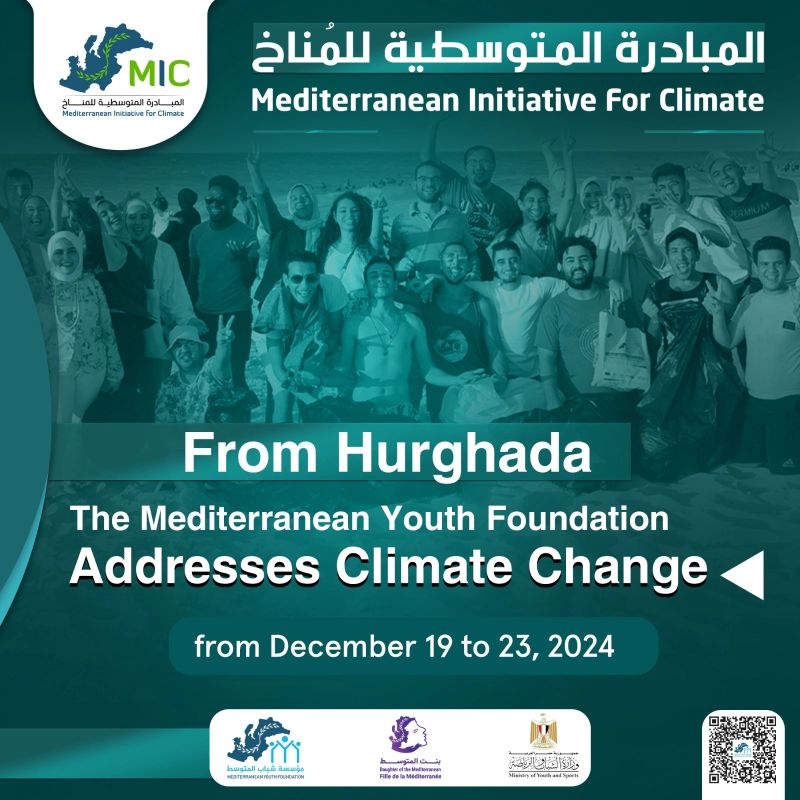
From Hurghada: The Mediterranean Youth Foundation Addresses Climate Change! The Mediterranean Youth Foundation, in collaboration with the Egyptian Ministry of Youth and Sports, is preparing to launch the second edition of our regional project, the Mediterranean Initiative for Climate, from December 19 to 23, 2024. The importance of the initiative stems from its response to the growing environmental challenges in the Mediterranean region, which accommodate more than 510 million people, and where temperatures are rising 20% faster than the global average, according to United Nations reports. This initiative aims to build capacities, develop environmental policies, and generate knowledge to raise awareness about climate change. It serves as a platform for interaction and cultural exchange among Mediterranean youth to innovate environmental solutions and address shared challenges. Stay tuned for event details and share your expectations with us!

“Ministry of Youth and Sports and Mediterranean Youth Foundation Continue to Address Climate Change” The Mediterranean Youth Foundation and the Ministry of Youth and Sports are continuing the activities of the second edition of the regional project “Mediterranean Initiative for Climate” from December 19 to 23, 2024. The initiative included a variety of sessions, ranging from workshops and listening sessions to research activities and presentations focusing on Gender Lens on Climate Change. These sessions were led by Dr. Yasmeen Aladdin, a gender expert and co-president of the Mediterranean Youth Foundation. The initiative also featured artistic performances by participants that addressed concepts such as loss and damage, mitigation and adaptation, and deep decarbonization, reflecting the initiative’s aim to translate climate action to the grassroots level. The importance of this initiative lies in responding to the increasing environmental challenges in the Mediterranean region, which accommodate more than 510 million people, where temperatures are rising 20% faster than the global average, according to UN Environment reports. Our journey in Hurghada for climate change has come to an end, but our efforts continue. Stay tuned for more updates!

The Mediterranean Youth Foundation, in collaboration with the Ministry of Youth and Sports, is organizing the second edition of the regional project, “The Mediterranean Initiative for Climate,” from December 19 to 23, 2024. This initiative aims to build the capacities of representatives of youth organizations and entities, develop environmental policies, and generate knowledge to raise awareness about climate change. It also seeks to explore the regional interaction mechanism between science and policies as recognized by the Barcelona Convention. The initiative includes diverse sessions such as workshops, hearings, research activities, and presentations on the conceptual framework and historical background of climate change, along with key related international agreements. It also featured a knowledge competition on climate and environmental terminology presented by Mr. Youssef Aroog. Additionally, the initiative hosted a session on climate diplomacy and translating climate action to the grassroots level, including mechanisms for negotiation between parties, presented by Mr. Mohamed Ageez, Climate Action Advisor at the Mediterranean Youth Foundation and Managing Partner at TIS Labs. The importance of this initiative lies in responding to the increasing environmental challenges in the Mediterranean region, which accommodate more than 510 million people, where temperatures are rising 20% faster than the global average, according to UN Environment reports. Our activities are still ongoing… Stay tuned! #Youth #peace #Youth4Mediterranean #MYF

Before the next United Nations (UN) Climate Change Conference 2022 (UNFCCC, COP 27) that will take place in Egypt in November 2022, the Mediterranean Youth Foundation for Development (MYF,) hosted  in cooperation with the “Oceans Network” through the Erasmus+ student and Alumni Alliance (ESAA EU,) funded by the “European Commission” with the support of the Egyptian Ministry of Youth and Sports and the Egyptian Ministry of Environment, brought together 55 youth aged 21-35 from the Euro-Mediterranean countries for a 3-day training covering the topic of climate change, in August 2022 in El- Alamein, Egypt.

How It Worked?

The aim of the initiative was to raise awareness about climate change and building the capabilities of youth in the field of climate change. In addition to the training, awareness raising campaigns and contests that have been organized on the same topic, engaging as many youths as possible with the priority topics of the upcoming COP27 (unemployment, The climate crisis, migration, gender inequality) and building the capacities of young men and women to face these challenges.

In a multicultural atmosphere, the Mediterranean Initiative for Climate was launched, with participation of 55 participants from different Mediterranean countries from Spain, Lebanon, Palestine, Bosnia and Herzegovina and Egypt which included about 10 workshops and panel discussions with approximately 50 training hours, and addressed a number of main topics of concern to everyone interested in the environment and climate change, namely environmental peace, challenges of the environment in the Mediterranean and mechanisms of mitigation and adaptation.

The workshops also dealt with how to write a policy paper specialized in the environment, and at the end of the program, the participants worked on writing and submitting policy papers, which will be evaluated and reviewed, to be presented to the officials.

How was social media used?

Before the workshops started, the Mediterranean Youth Foundation launched an online awareness campaign to educate the audience about the issue of climate change, the dangers of using plastic, and how they can contribute to reducing the effects of climate change by publishing a set of posters and infographics.

Also, two competitions were launched. The first was a question competition, the winners received a set of prizes, from an opportunity to participate in the workshops to financial prizes and certificates of appreciation, and the second competition was an article competition, where the participants worked on writing articles on the issue of climate change in Arabic and English. A team of professionals assessed them, and the essay competition winners were allowed to participate in the workshops and receive monetary prizes.

Outcomes 

We are at a critical moment in human history. We are facing a dangerous issue that needs individuals, communities, local, regional and global organizations and governments to come together to reduce the effects of climate change. In November 2022, world leaders will gather at the United Nations Climate Change Conference, an important event in our journey to tackle climate change. We came out of the Mediterranean Initiative for Climate with a set of recommendations, which are as follows:

  1. The necessity of activating and accelerating climate policies worldwide and involving youth in a greater way in limiting the effects of climate change.
  2. Climate action cannot be postponed for the next decade, next year, or tomorrow. We all have to take action now.
  3. There is an urgent need to view the environment as an essential human right.
  4. Governments and local, regional, and international organizations need to strengthen the channels of communication between them, and governments should strengthen the channels of participation at the national and international levels in all stages of planning, implementation, evaluation, and monitoring of climate action policies and programs.

In the end, it can be said that this initiative was an excellent opportunity to pave the way for the Climate Summit, as it was necessary to involve a group of young people from all over the world to exchange views, experiences, and cultures, to come up with a set of policies that can be presented to governments to reduce the effects of climate change.

*A Funded Opportunity for Those Interested in Climate Action in Egypt – The Mediterranean Initiative for Climate MIC*.

Are you a climate action activist?
Do you have an idea or a recommendation in the field of climate and you need a financial or technical support?
Are you between 18 and 35 years old?
If your answers are yes, then this is your opportunity to be part of the change.

Apply now for the 4th edition of the Mediterranean Initiative for Climate (MIC) and receive free training and a chance to obtain a financial support up to 500 USD.

The project is implemented by the Mediterranean Youth Foundation (MYF) under the patronage of the Egyptian Ministry of Environment and in cooperation with Misr El-Kheir Foundation and Population Matters. The 4th edition focuses on three key pillars:

Building youth capacity, enhancing climate knowledge, and understanding international efforts and the outcomes of climate summits.
Empowering youth through field environmental initiatives and providing direct financial support.
Supporting their participation in decision-making by training them on how to prepare policy papers and provide badges to attend official climate negotiations.

Benefits of participation:

Receive free training on climate change, its historical background, and international efforts.
The possibility of obtaining micro-technical and financial support up to 500 USD to fund environmental initiatives and projects.
Participate in the preparation of policy papers with the possibility of obtaining badges to attend official climate negotiations such as COP-SB.

Note: This project is funded, and there are no fees for participation.

The final deadline for registration is December 20, 2025, at 11PM Cairo Time.

The third edition of the Mediterranean Initiative for Climate (MIC) is being launched from Ras El Bar, Egypt. In parallel with the Local Conference of Youth (LCOY Egypt 2025), the Mediterranean Youth Foundation and its partners launched the third edition of our strategic project, the “Mediterranean Initiative for Climate.” The initiative is jointly supported by the Council of Europe and the European Union and is being implemented in Egypt by the Mediterranean Youth Foundation, under the joint patronage of the Ministry of Youth and Sports and the Ministry of Environment. The events kicked off with ice-breaking sessions and energizing activities, followed by interactive workshops addressing key climate change questions: What is it? When did it start? How was the response of the international community? What is the role of cultural dialogue in fostering Euro-Mediterranean cooperation? This initiative comes as part of the foundation’s plan to develop the skills and build the capacities of civil society actors, aiming for sustainable development driven by youth leadership. Aroog also facilitated an analytical session that explored the evolution of international frameworks to combat climate change , starting from the United Nations Framework Convention on Climate Change (UNFCCC), followed by the Kyoto Protocol, and then the Paris Agreement, all the way up to the long-term European Green Deal, which aims to make the EU the first climate-neutral continent by achieving net-zero emissions by 2050! A rich sequence that reflects how the international community’s response to the climate issue has evolved, and highlights the importance of continued cross-border cooperation for a more sustainable future. Stay tuned for upcoming events and reports.

Play4Peace

Project Reference: 2021-1-DE04-KA153-YOU-000010937

Project Status

Completed

  • Start date 01-11-2021
  • End date 31-10-2023

EU Grant

43.519,58 €

Programme

Erasmus+

Key Action

Learning Mobility of Individuals

Action Type

Mobility of youth workers

Countries covered

17

  • New learning and teaching methods and approaches
  • Preventing racism and discrimination
  • Quality and innovation of youth work

Summary

Objectives

The primary goal of our project was to critically assess and enhance the role of games in non-formal education within the context of volunteer and youth activities. Usually, the use of games in these settings needs more substantial reflection on their advantages, challenges, and potential drawbacks. While games are widely employed for team building and content delivery, the project aimed to address and mitigate issues such as the reproduction of stereotypes, oversight of power structures, exclusion of individuals with disabilities, and violations of personal space.

Our objectives encompassed:

1. Critical Reflection on Games in Non-formal Education:

· Sensitised participants to various forms of discrimination.

· Created safer spaces to enhance inclusivity in youth and volunteering projects.

2. Intersectional Perspectives:

· Raised awareness and understanding of global justice, gender, class, race, inclusion, and climate justice in game facilitation.

· Developed and shared inclusive, diverse, and power-critical games.

3. Building on Partner Experiences:

· Built on partners’ diverse experiences with seminar contexts, target groups, and perspectives related to games in non-formal education.

4. Promoting Peace and Human Rights in Games:

· We deepened our understanding of the role of peace and human rights in games used for educational purposes.

5. Quality Improvement in Non-formal Education Instruments:

· Enhance the quality of non-formal education instruments for use in future events, projects, trainings, seminars, and general meetings.

6. Empowering Youth Workers:

· We aimed to provide youth workers with tools and methods for power-critical, inclusive, and peaceful games in educational work.

7. Manual Creation:

· A significant outcome of our project is the development of a comprehensive manual for games in educational work. This manual encompasses underlying concepts, shared experiences with safe spaces in games, and guidelines for peaceful playing.

8. Building Alliances and Solidarity:

· We believe we created a more robust alliance and solidarity within the peace and volunteering movement. This involves fostering collaboration among the organizations involved in this project and establishing networks for future cooperation and peace-education projects.

Ultimately, the project sought to contribute to active participation in democratic life, social and civic engagement, and the establishment of a more inclusive and peaceful educational environment. The phased approach, including online preparation, offline training, implementation, reflection, and follow-up, ensured a thorough and iterative process toward the achievement of these objectives.

Implementation

Online preparation period: questions and tasks to reflect on were distributed beforehand, so that participants were on the same level at the beginning of the training. Before the training we also had an online kick off meeting with all participants.

A Training that focused on the reflection of the use of games and playful methods in youth and other non-formal learning projects. It focused on the advantages and challenges of games, their connection to discrimination, inclusion and safer spaces. First steps for the creation of the manual were also included in the training as well as an outlook to the implementation period. The training was hosted by SCI Germany and took place in Sonthofen on 16.-23.04.2022, with 31 participants from organisations in Germany, Austria, North Macedonia, Turkey, Slovenia, Catalunya, Tunisia, Albania, France, Spain, Georgia, Bulgaria, Tunisia, Egypt, Jordan, and Belgium.

Implementation phase: the participants used the knowledge they gained during the training to implement critical points and ideas on how to use games more carefully in their youth activities. They were asked to do a small personal reflection on each game they facilitated during their activities

In an offline seminar, participants reflected on their experiences with the games during the activities in the implementation phase and discussed them further to develop the manual. The group also discussed some topics that came up during the previous activities and there was time for discussing and planning related follow-up projects. The seminar took place from 16.-22.10.2022 in Mali Idjos (Serbia) with 18 participants from organisations in Germany, Serbia, North Macedonia, Turkey, Catalunya, France, Georgia, and Egypt.

Follow-up phase: participants included their learnings in their own educational activities and continued the finalisation of the manual

Participants were youth workers and staff or volunteers in volunteering and youth organisations in the above-mentioned countries as well as peace activists. They came from organisations that have expressed a need or interest in having intense discussions around discrimination and games in their educational work. Besides Participants belonging to a hetero-normative white able-bodies Norm, we also had participants from different marginalised group, as queer persons, Roma, Persons of Color, Neurodivergent persons and other regional marginalised groups.

Results

Our project directly impacted the participating youth workers by raising awareness for challenges and opportunities of, as well as discrimination and stereotypes in educational games. Participants felt more secure when introducing playful methods in their youth work and got motivation to improve them, as the discussions and methods used during the project gave them new inspiration, approaches, understandings and tools. During the project, they got to know peaceful and power-critical games and learned how to evaluate game-like methods critically. Besides the project content, they learned more about the Erasmus+ program and got to know and connected to youth workers from other European countries.

The participating organisations benefited from this project by sharing their perspectives with the other participating organisations. Moreover, they were able to ensure a higher quality of their youth projects, as young people experienced discrimination-free and power-critical games. As the project encouraged the development of follow-up projects, participating organisations hosted, or participated in further activities. Follow Up Activities took place for example in Germany, Belgium, Serbia, Jordan, Spain or Egypt.

We captured the project outcome in a manual for games in educational work that included underlying concepts, shared experiences, and guidelines for peaceful playing. On the one hand, this manual serves participating youth workers as support for their youth activities after the project’s lifetime. In addition, the manual allows for sharing findings and methods with other youth workers and organisations. By developing this manual during the project, we therefore aimed at improving the quality of NFE instruments for future youth activities, trainings, seminars, and general meetings within but also beyond the participating organisations.

The manual was co-created by the participants and was widely shared both in the organisations and networks involved in this project as well as in the tool database on SALTO.

Through this project, they furthermore formed stronger alliances and solidarity in the peace and volunteering movement with other European organisations

Through this project, we strengthened the visibility of antidiscrimination, inclusion and diversity and its connection to youth work and non-formal education the European volunteering and youth work. Participants left the projects with the skills to critically reflect both their own and their organisation‘s educational practices and they will be able to be more inclusive and diverse in their educational projects.