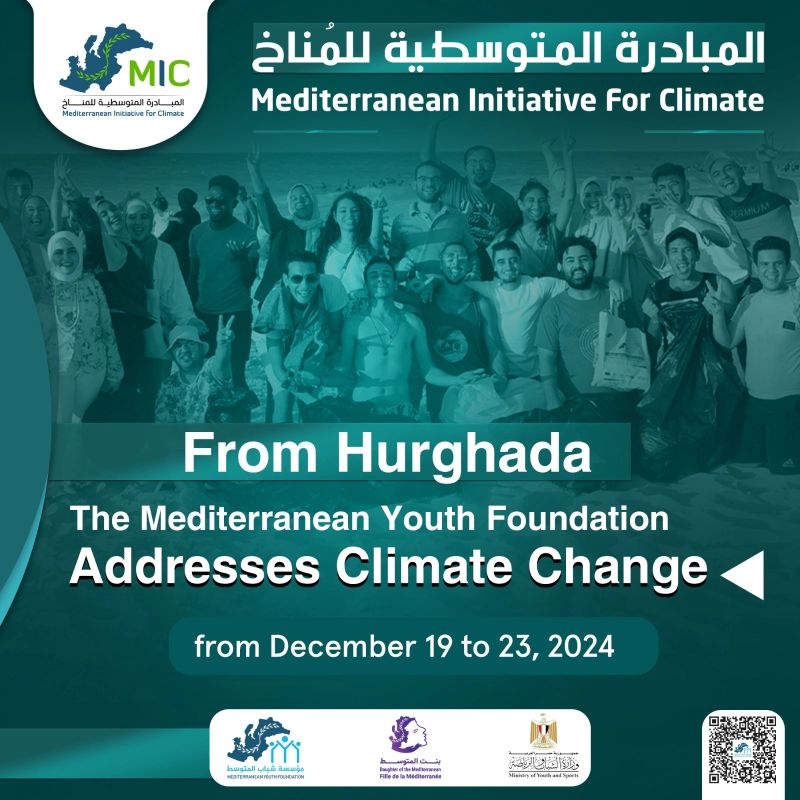
From Hurghada: The Mediterranean Youth Foundation Addresses Climate Change! The Mediterranean Youth Foundation, in collaboration with the Egyptian Ministry of Youth and Sports, is preparing to launch the second edition of our regional project, the Mediterranean Initiative for Climate, from December 19 to 23, 2024. The importance of the initiative stems from its response to the growing environmental challenges in the Mediterranean region, which accommodate more than 510 million people, and where temperatures are rising 20% faster than the global average, according to United Nations reports. This initiative aims to build capacities, develop environmental policies, and generate knowledge to raise awareness about climate change. It serves as a platform for interaction and cultural exchange among Mediterranean youth to innovate environmental solutions and address shared challenges. Stay tuned for event details and share your expectations with us!

“Ministry of Youth and Sports and Mediterranean Youth Foundation Continue to Address Climate Change” The Mediterranean Youth Foundation and the Ministry of Youth and Sports are continuing the activities of the second edition of the regional project “Mediterranean Initiative for Climate” from December 19 to 23, 2024. The initiative included a variety of sessions, ranging from workshops and listening sessions to research activities and presentations focusing on Gender Lens on Climate Change. These sessions were led by Dr. Yasmeen Aladdin, a gender expert and co-president of the Mediterranean Youth Foundation. The initiative also featured artistic performances by participants that addressed concepts such as loss and damage, mitigation and adaptation, and deep decarbonization, reflecting the initiative’s aim to translate climate action to the grassroots level. The importance of this initiative lies in responding to the increasing environmental challenges in the Mediterranean region, which accommodate more than 510 million people, where temperatures are rising 20% faster than the global average, according to UN Environment reports. Our journey in Hurghada for climate change has come to an end, but our efforts continue. Stay tuned for more updates!

The Mediterranean Youth Foundation, in collaboration with the Ministry of Youth and Sports, is organizing the second edition of the regional project, “The Mediterranean Initiative for Climate,” from December 19 to 23, 2024. This initiative aims to build the capacities of representatives of youth organizations and entities, develop environmental policies, and generate knowledge to raise awareness about climate change. It also seeks to explore the regional interaction mechanism between science and policies as recognized by the Barcelona Convention. The initiative includes diverse sessions such as workshops, hearings, research activities, and presentations on the conceptual framework and historical background of climate change, along with key related international agreements. It also featured a knowledge competition on climate and environmental terminology presented by Mr. Youssef Aroog. Additionally, the initiative hosted a session on climate diplomacy and translating climate action to the grassroots level, including mechanisms for negotiation between parties, presented by Mr. Mohamed Ageez, Climate Action Advisor at the Mediterranean Youth Foundation and Managing Partner at TIS Labs. The importance of this initiative lies in responding to the increasing environmental challenges in the Mediterranean region, which accommodate more than 510 million people, where temperatures are rising 20% faster than the global average, according to UN Environment reports. Our activities are still ongoing… Stay tuned! #Youth #peace #Youth4Mediterranean #MYF

Before the next United Nations (UN) Climate Change Conference 2022 (UNFCCC, COP 27) that will take place in Egypt in November 2022, the Mediterranean Youth Foundation for Development (MYF,) hosted  in cooperation with the “Oceans Network” through the Erasmus+ student and Alumni Alliance (ESAA EU,) funded by the “European Commission” with the support of the Egyptian Ministry of Youth and Sports and the Egyptian Ministry of Environment, brought together 55 youth aged 21-35 from the Euro-Mediterranean countries for a 3-day training covering the topic of climate change, in August 2022 in El- Alamein, Egypt.

How It Worked?

The aim of the initiative was to raise awareness about climate change and building the capabilities of youth in the field of climate change. In addition to the training, awareness raising campaigns and contests that have been organized on the same topic, engaging as many youths as possible with the priority topics of the upcoming COP27 (unemployment, The climate crisis, migration, gender inequality) and building the capacities of young men and women to face these challenges.

In a multicultural atmosphere, the Mediterranean Initiative for Climate was launched, with participation of 55 participants from different Mediterranean countries from Spain, Lebanon, Palestine, Bosnia and Herzegovina and Egypt which included about 10 workshops and panel discussions with approximately 50 training hours, and addressed a number of main topics of concern to everyone interested in the environment and climate change, namely environmental peace, challenges of the environment in the Mediterranean and mechanisms of mitigation and adaptation.

The workshops also dealt with how to write a policy paper specialized in the environment, and at the end of the program, the participants worked on writing and submitting policy papers, which will be evaluated and reviewed, to be presented to the officials.

How was social media used?

Before the workshops started, the Mediterranean Youth Foundation launched an online awareness campaign to educate the audience about the issue of climate change, the dangers of using plastic, and how they can contribute to reducing the effects of climate change by publishing a set of posters and infographics.

Also, two competitions were launched. The first was a question competition, the winners received a set of prizes, from an opportunity to participate in the workshops to financial prizes and certificates of appreciation, and the second competition was an article competition, where the participants worked on writing articles on the issue of climate change in Arabic and English. A team of professionals assessed them, and the essay competition winners were allowed to participate in the workshops and receive monetary prizes.

Outcomes 

We are at a critical moment in human history. We are facing a dangerous issue that needs individuals, communities, local, regional and global organizations and governments to come together to reduce the effects of climate change. In November 2022, world leaders will gather at the United Nations Climate Change Conference, an important event in our journey to tackle climate change. We came out of the Mediterranean Initiative for Climate with a set of recommendations, which are as follows:

  1. The necessity of activating and accelerating climate policies worldwide and involving youth in a greater way in limiting the effects of climate change.
  2. Climate action cannot be postponed for the next decade, next year, or tomorrow. We all have to take action now.
  3. There is an urgent need to view the environment as an essential human right.
  4. Governments and local, regional, and international organizations need to strengthen the channels of communication between them, and governments should strengthen the channels of participation at the national and international levels in all stages of planning, implementation, evaluation, and monitoring of climate action policies and programs.

In the end, it can be said that this initiative was an excellent opportunity to pave the way for the Climate Summit, as it was necessary to involve a group of young people from all over the world to exchange views, experiences, and cultures, to come up with a set of policies that can be presented to governments to reduce the effects of climate change.

*A Funded Opportunity for Those Interested in Climate Action in Egypt – The Mediterranean Initiative for Climate MIC*.

Are you a climate action activist?
Do you have an idea or a recommendation in the field of climate and you need a financial or technical support?
Are you between 18 and 35 years old?
If your answers are yes, then this is your opportunity to be part of the change.

Apply now for the 4th edition of the Mediterranean Initiative for Climate (MIC) and receive free training and a chance to obtain a financial support up to 500 USD.

The project is implemented by the Mediterranean Youth Foundation (MYF) under the patronage of the Egyptian Ministry of Environment and in cooperation with Misr El-Kheir Foundation and Population Matters. The 4th edition focuses on three key pillars:

Building youth capacity, enhancing climate knowledge, and understanding international efforts and the outcomes of climate summits.
Empowering youth through field environmental initiatives and providing direct financial support.
Supporting their participation in decision-making by training them on how to prepare policy papers and provide badges to attend official climate negotiations.

Benefits of participation:

Receive free training on climate change, its historical background, and international efforts.
The possibility of obtaining micro-technical and financial support up to 500 USD to fund environmental initiatives and projects.
Participate in the preparation of policy papers with the possibility of obtaining badges to attend official climate negotiations such as COP-SB.

Note: This project is funded, and there are no fees for participation.

The final deadline for registration is December 20, 2025, at 11PM Cairo Time.

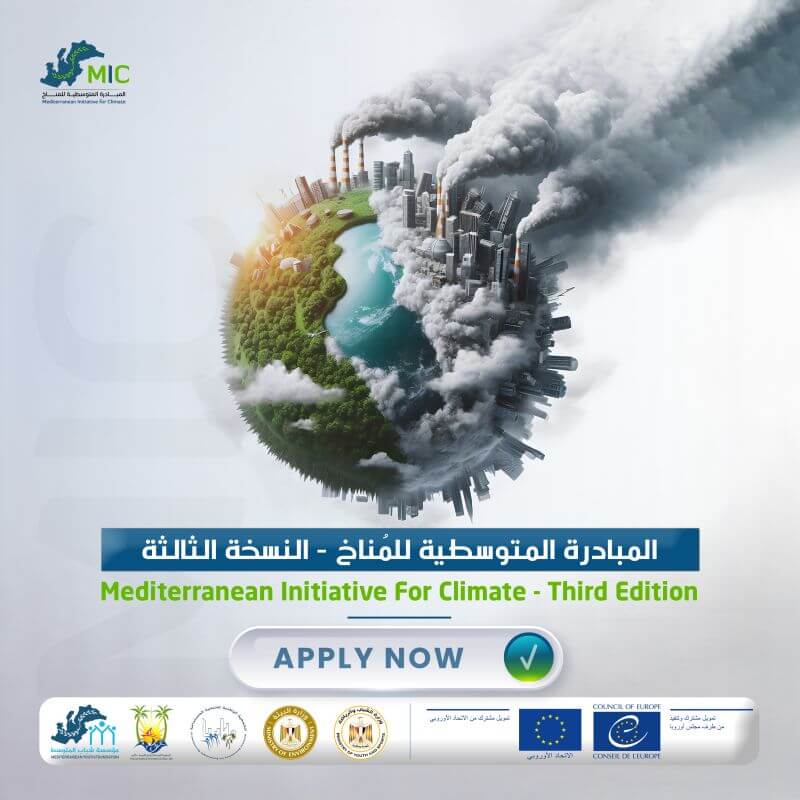
The third edition of the Mediterranean Initiative for Climate (MIC) is being launched from Ras El Bar, Egypt. In parallel with the Local Conference of Youth (LCOY Egypt 2025), the Mediterranean Youth Foundation and its partners launched the third edition of our strategic project, the “Mediterranean Initiative for Climate.” The initiative is jointly supported by the Council of Europe and the European Union and is being implemented in Egypt by the Mediterranean Youth Foundation, under the joint patronage of the Ministry of Youth and Sports and the Ministry of Environment. The events kicked off with ice-breaking sessions and energizing activities, followed by interactive workshops addressing key climate change questions: What is it? When did it start? How was the response of the international community? What is the role of cultural dialogue in fostering Euro-Mediterranean cooperation? This initiative comes as part of the foundation’s plan to develop the skills and build the capacities of civil society actors, aiming for sustainable development driven by youth leadership. Aroog also facilitated an analytical session that explored the evolution of international frameworks to combat climate change , starting from the United Nations Framework Convention on Climate Change (UNFCCC), followed by the Kyoto Protocol, and then the Paris Agreement, all the way up to the long-term European Green Deal, which aims to make the EU the first climate-neutral continent by achieving net-zero emissions by 2050! A rich sequence that reflects how the international community’s response to the climate issue has evolved, and highlights the importance of continued cross-border cooperation for a more sustainable future. Stay tuned for upcoming events and reports.

The EU does not need 80 euros from youth in developing countries

Statement by the Mediterranean Youth Foundation for Development: “Towards a More Efficient Visa Acquisition Process for Greater International Mobility”

The Mediterranean Youth Foundation for Development – MYF strongly urges Schengen Area countries to adopt more efficient and economically advantageous practices for the visa acquisition process in Egypt. We also invite other countries to adopt common practices to build a communicative network among developing countries in the Mediterranean area, ensuring broader international mobility.

In Southern Mediterranean countries, the high visa fee of 80 EUR, coupled with the difficulty of securing appointments through intermediaries like BLS International and TLScontact, create a substantial barrier for young people seeking international mobility. These intermediaries play a fundamental role in managing visa applications but also present numerous problems that can severely hinder the process by encouraging irregular practices.

These practices include imposing unofficial additional costs, for example, applicants from Europe often pay significantly less; a mere 25 USD or even enjoy visa-free entry to some countries like Morocco. In contrast, applicants in Southern Mediterranean countries often end up paying three times the official fee: once to the embassy, again to a service provider hired by the embassy, a third time to prepare and translate the list of required documents, and may sometimes have to pay a fourth time to buy an appointment at embassy to begin with, further burdening applicants who often face unforeseen expenses and navigate a complex and opaque bureaucratic system. 

Similarly to Egypt, the visa issuance procedures in countries like Morocco and Tunisia are characterized by a lack of transparency. These unclear and often bureaucratically complex processes hinder individuals from moving. Improving transparency and simplifying visa acquisition procedures is essential to promote inclusive mobility and supporting the personal and professional development of people. 

Additionally, visa fees imposed on citizens of underdeveloped nations create an unjust barrier to travel; this system disproportionately affects those with fewer resources, hindering opportunities for cultural exchange, education, and business ventures.  Instead of promoting a level playing field, these fees exacerbate existing inequalities and hinder the pursuit of social justice, limiting the ability of individuals from developing countries to participate in the global community, as well as deepening the development gap between the North and the South.

MYF aims to raise awareness among authorities about the benefits of a more efficient and accessible system, inspired by the German model, which represents an exemplary model of how efficient and transparent management can facilitate international mobility. This country has implemented a clear, accessible visa issuance system supported by a series of facilitations and economic exemptions, especially for school, university, and postgraduate students. These policies, combined with a well-organized visa issuance system, not only 

reduce economic and bureaucratic barriers but also promote a broader and more inclusive international exchange, fundamental for the economic and social progress of the country. 

MYF proposes a shared application mechanism to ensure an equal, transparent and inclusive visa issuance system:

Ensure the Regional implementation of Student Exemptions: Develop a unified mechanism that monitors and ensures the visa fee exemption of school, university, and postgraduate students. These exemptions significantly reduce economic barriers and allow for more equitable access to international education and cultural exchange. Although these exemptions already exist in certain countries like Austria, which allows visa free entry for students, it is necessary to ensure they are effectively enforced on a wider scale.

Civil Society Workers’ Exemptions: Implement exemptions for workers of non-governmental organizations (NGOs), exempting them from paying the visa fee. These exemptions significantly reduce economic barriers and allow for more equitable access to international collaboration and community service. Given that NGOs are community-serving entities funded independently through donations and grants, it is essential to ensure these exemptions are effectively enforced.

Use of Digital Tools: We propose implementing practices that ensure transparency through the use of digital technologies, such as online platforms, allowing applicants to monitor the status of their visa applications in real-time. Furthermore, the regular publication of detailed guidelines and updates on visa issuance procedures will help keep the process clear and understandable for all students, improving accessibility and reducing opportunities for corruption.

Tighter Regulations: To ensure a fair and transparent system, we need tighter regulations. These regulations should address the monopolization of visa appointments by third parties, who profit by creating unnecessary demand and inflating costs for legitimate travelers. 

We emphasize the importance of adopting these regulatory practices as they offer significant opportunities for economic and social growth. By simplifying and clarifying the visa application process, we can promote greater international mobility as well as greater innovation and development within host countries. The adoption of these practices can yield long-term benefits, strengthening the socio-economic fabric of nations and contributing to a more connected world. 


الاتحاد الأوروبي ليس بحاجه إلي ٨٠ يورو من شباب/ات الدول النامية

بيان صادر عن مؤسسة شباب المتوسط للتنمية: “الاتحاد الأوروبي ليس بحاجة إلى 80 يورو من شباب/ات الدول النامية”

تحث مؤسسة شباب المتوسط للتنمية بقوة دول منطقة شنغن على اعتماد ممارسات أكثر كفاءة وأكثر فائدة اقتصاديًا لإجراءات الحصول على التأشيرة في مصر. كما ندعو الدول الأخرى إلى تبني ممارسات مشتركة لبناء شبكة اتصال بين الدول النامية في منطقة البحر الأبيض المتوسط، مما يضمن تحركًا دوليًا أوسع نطاقًا.

في مصر ، تبلغ رسوم التأشيرة المرتفعة 80 يورو، إلى جانب صعوبة الحصول على مواعيد من خلال الوسطاء مثل

BLS International و TLScontact

، يمثل ذلك عقبة كبيرة أمام الشباب/ات الذين يسعون إلى التنقل الدولي. يلعب هؤلاء الوسطاء دورًا أساسيًا في إدارة طلبات التأشيرة ولكنهم يمثلون أيضًا العديد من المشكلات التي يمكن أن تعيق العملية بشدة من خلال تشجيع الممارسات غير القانونية ، مثل فرض تكاليف إضافية غير رسمية وتقديم خدمات مسار سريع غير موثوقة تعد بالموافقة السريعة على التأشيرة ، مما يثقل كاهل المتقدمين الذين غالبًا ما يواجهون نفقات غير متوقعة ويتنقلون في نظام بيروقراطي معقد وغير شفاف

على غرار مصر ، تتميز إجراءات إصدار التأشيرات في دول مثل المغرب وتونس بانعدام الشفافية. تعيق هذه العمليات غير الواضحة وغالبًا ما تكون معقدة بيروقراطيًا الأفراد عن الحركة. إن تحسين الشفافية وتبسيط إجراءات الحصول على التأشيرة أمر ضروري لتعزيز التنقل الشامل ودعم التنمية الشخصية والمهنية للأشخاص

بالإضافة إلى ذلك ، فإن رسوم التأشيرة المفروضة على مواطني الدول النامية تشكل عقبة غير عادلة أمام السفر ؛ يؤثر هذا النظام بشكل غير متناسب على أولئك الذين لديهم موارد أقل ، مما يعيق فرص التبادل الثقافي والتعليم والمشاريع التجارية. بدلاً من تعزيز تكافؤ الفرص ، تعمل هذه الرسوم على تفاقم التفاوتات القائمة وتعوق السعي لتحقيق العدالة الاجتماعية ، مما يحد من قدرة الأفراد من الدول النامية على المشاركة في المجتمع العالمي ، وكذلك يعمق الفجوة التنموية بين الشمال والجنوب

تهدف مؤسسة شباب المتوسط للتنمية إلى رفع مستوى الوعي بين السلطات حول مزايا نظام أكثر كفاءة، مستوحى من النموذج الألماني ، والذي يمثل نموذجًا مثاليًا للإدارة الفعالة والشفافة التي تسهل التنقل الدولي. نفذت هذه الدولة نظامًا واضحًا لإصدار التأشيرات سهل الوصول إليه بدعم من سلسلة من التسهيلات والإعفاءات الاقتصادية ، خاصة للطلاب/ات في المدارس والجامعات والدراسات العليا. هذه السياسات ، إلى جانب نظام إصدار تأشيرات منظم جيدًا ، لا تقلل فقط من العقبات الاقتصادية والبيروقراطية ولكنها تعزز أيضًا تبادلًا دوليًا أوسع وأكثر شمولية ، وهو أمر أساسي للتقدم الاقتصادي والاجتماعي للبلد

تقترح مؤسسة شباب المتوسط آلية تطبيق مشتركة لضمان نظام إصدار تأشيرات عادل وشفاف وشامل:

  • ضمان التنفيذ الإقليمي لإعفاءات الطلاب/ات:  تطوير آلية موحدة لمراقبة وضمان إعفاء رسوم التأشيرة للطلاب/ات في المدارس والجامعات والدراسات العليا. تساهم هذه الإعفاءات بشكل كبير في تقليل العقبات الاقتصادية وتتيح وصولاً أكثر عدالة إلى التعليم الدولي والتبادل الثقافي. على الرغم من وجود هذه الإعفاءات بالفعل في بعض الدول مثل النمسا التي تسمح بدخول الطلاب/ات بدون تأشيرة، فمن الضروري ضمان تطبيقها بفعالية على نطاق أوسع.

  • إعفاءات العاملين/ات في المجتمع المدني: تطبيق إعفاءات لموظفي المنظمات غير الحكومية (المنظمات الأهلية) من دفع رسوم التأشيرة. تساهم هذه الإعفاءات بشكل كبير في تقليل العقبات الاقتصادية وتتيح وصولاً أكثر عدالة إلى التعاون الدولي والخدمة المجتمعية. ونظراً لأن المنظمات غير الحكومية هي كيانات تخدم المجتمع وتمول بشكل مستقل من خلال التبرعات والمنح، فمن الضروري ضمان تطبيق هذه الإعفاءات بفعالية
  • استخدام الأدوات الرقمية: نقترح تنفيذ ممارسات تضمن الشفافية من خلال استخدام التقنيات الرقمية ، مثل المنصات الإلكترونية ، التي تسمح للمتقدمين بمراقبة حالة طلبات التأشيرة الخاصة بهم في الوقت الفعلي. علاوة على ذلك ، فإن النشر الدوري للإرشادات التفصيلية والتحديثات حول إجراءات إصدار التأشيرات سيساعد في الحفاظ على الوضوح والسهولة في فهم العملية لجميع الطلاب ، مما يحسن إمكانية الوصول ويقلل من فرص الفساد.

  • لوائح أكثر صرامة: لضمان نظام عادل وشفاف ، نحتاج إلى لوائح أكثر صرامة. يجب أن تتناول هذه اللوائح احتكار مواعيد التأشيرة من قبل أطراف ثالثة ، الذين يستفيدون من خلق طلب غير ضروري ورفع التكاليف للمسافرين/ات الشرعيين/ات.

نؤكد على أهمية اعتماد هذه الممارسات التنظيمية لأنها توفر فرصًا كبيرة للنمو الاقتصادي والاجتماعي. من خلال تبسيط وتوضيح عملية تقديم طلب التأشيرة ، يمكننا تعزيز حركة دولية أكبر وكذلك المزيد من الابتكار والتطوير داخل البلدان المضيفة. يمكن أن يؤدي اعتماد هذه الممارسات إلى فوائد طويلة الأجل ، وتعزيز النسيج الاجتماعي والاقتصادي للدول والمساهمة في عالم أكثر ارتباطًا.