

A Call to Extend the Hours of Women's Carriages on the Metro Until the End of Service.
EVENTS
EVENTS
MEDIA
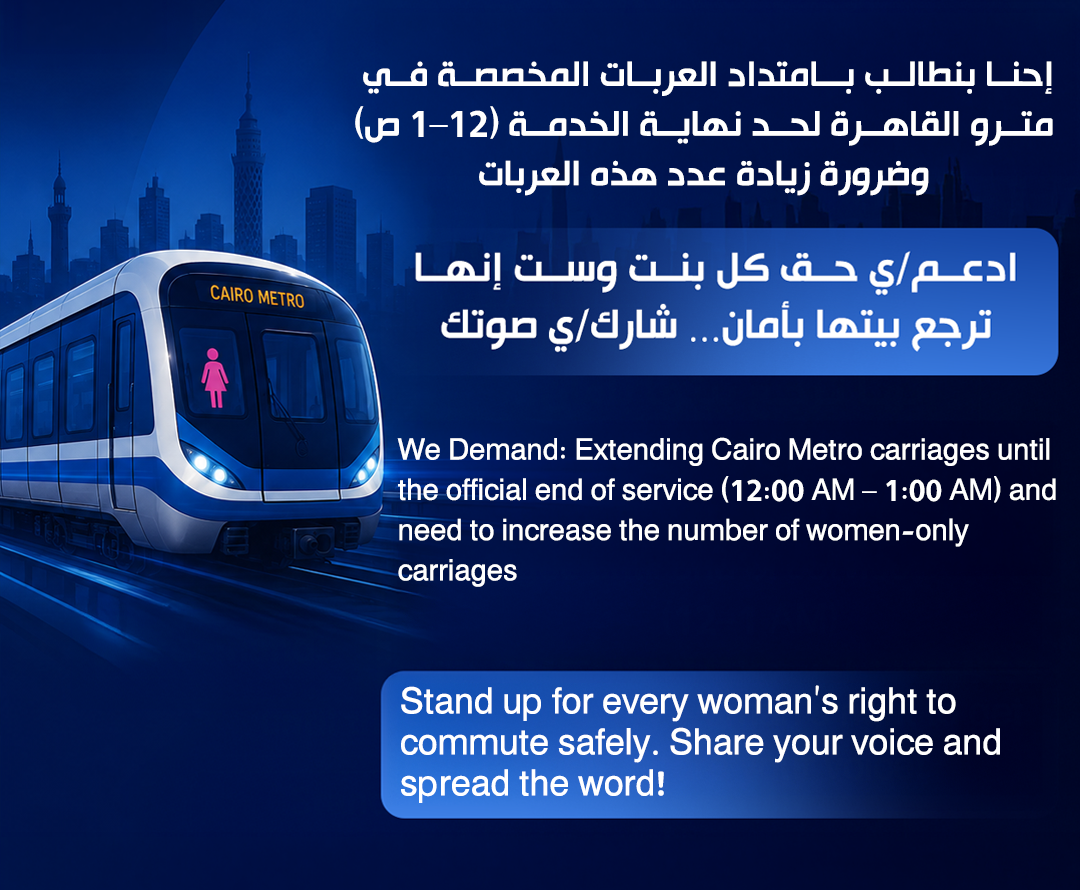
Women's safety doesn't end at 9 PM: MYF calls for extending the hours of women's carriages on the metro until the end of service
Egyptian Women’s right to safe mobility should not come to an end when the clock strikes 9 PM. The transition to mixed-use metro carriages after 9 PM constitutes an imminent danger and a heightened vulnerability at sharply the hours where robust safety measures ought to be the strongest. What has been termed “hours of horror”, the rush of men and their storming of the women’s carriages after 9 PM under the pretext that they have become mixed exposes women and girls to serious risks, including harassment, theft, and verbal and physical assaults.
The Mediterranean Youth Foundation for Development (MYF) strongly urges the Ministry of Transport, the National Authority for Tunnels, the Ministry of Interior of Egypt, and the National Council for Women to urgently revise the regulations on women-only carriages in the Cairo Metro, extend their operation beyond the 9:00 PM cutoff to the end of daily service, and dedicate half of all metro carriages exclusively to women, a direct, proportional measure that would substantively enhance their sense of safety and security in public transportation.
Ensuring safe mobility for women is not only a matter of public safety and individual rights, but also a key component of Egypt’s broader development agenda. The ability of women to move freely, safely, and affordably is closely linked to their participation in education, employment, public life, and economic activity. In this regard, extending the operation of women-only metro carriages until the end of daily service directly supports the objectives of Egypt Vision 2030, particularly those related to gender equality, social justice, women’s economic empowerment, and sustainable urban development. A transportation system that enables women to access opportunities without fear or restriction contributes to a more inclusive and productive society.
This call is also aligned with the United Nations Sustainable Development Goals (SDGs), particularly Goal 5 on achieving gender equality and empowering all women and girls, and Goal 11 on making cities and human settlements inclusive, safe, resilient, and sustainable. Creating transportation systems that respond to the safety needs of women is an essential element of building inclusive cities and ensuring that no one is left behind. By extending women-only metro carriages until the end of service hours and strengthening safety measures across the metro network, Egypt would be taking a practical step toward advancing both its national development priorities and its international commitments to equality, inclusion, and sustainable development.
Women’s Safety and Segregation Policies in Cairo Metro
- The Cairo metro is an important part of the everyday life of millions of women in Egypt because it provides an opportunity to travel quickly at an affordable price. Nonetheless, a woman’s commute does not only involve getting there but is also about finding a way to remain safe in public.
- The institutional decision to reserve specific cars for women in the Cairo Metro dates back to 1989, just two years after the first subway line was commissioned. This policy was initially introduced as a response to massive road congestion and the need to manage the “new types of behavior” resulting from the introduction of a modern technological subway system.
- While the measure is often associated today with preventing sexual harassment, in the late 1980s sexual harassment had not yet emerged as a public problem in Egypt. Instead, the separation was primarily intended to provide women with more “comfort” and safety amidst the great density of passengers. Furthermore, it served a “civilizing” dimension, aimed at modernizing urban behavior and ensuring the subway remained an international, “high-tech” symbol of urban civilization.
- The current confusion within the Cairo Metro stems from operating two different types of women-only carriages simultaneously. The first type is permanently designated for women from the start of service until closing (approximately 12:00 – 1:00 AM), with men strictly prohibited at all times. The second type operates conditionally: it is reserved for women only until 9:00 PM, after which it converts into a mixed-use carriage.
- The official justification for this time limit relies on operational logic: authorities argue that ‘rush hour’ ends by 9:00 PM. This conditional aspect creates a significant disjunction in the safety regime. When the second carriage reverts to mixed-use after 9:00 PM, this change in time is an opportunity for harassers and intruders to present an argument that they have lawful access to the women’s area. This compromises the entire intent and purpose of women-only areas, particularly during periods of least congestion at stations when it is most important for women to feel safe and secure.
Why Women’s Safety Cannot Be Time-Restricted
- Women’s sense of insecurity in Cairo’s public transport peaks in the evening and at night, with women reporting far higher levels of fear and discomfort after dark. As a result, many women have been forced to impose informal “curfews” on themselves, restricting their movement to certain hours of the day and relying on male family members to accompany them after sunset.
- This pattern of self-imposed restriction represents a direct curtailment of women’s rights to the city. By withdrawing one women’s carriage at 9:00, the metro authority inadvertently validates and reinforces this dynamic rather than counteracting it. Women who work late shifts, attend evening classes, or return from family visits are left most exposed at the very moment the city’s safest transit option reduces its protection.
- More than 80% of women surveyed experience harassment at some stage of their commute. This encompasses the walk to stations, the wait on platforms, the boarding process, and the ride itself.
- Crucially, even with separate women’s carriages on the metro, the high reported frequency of harassment likely reflects poor security at station entrances, ticketing areas, and platforms, spaces that are mixed-gender and effectively unprotected. This evidence underscores that the women’s carriage, while vital, is part of a larger safety ecosystem that must be reinforced and consistent across the entire service day
- An overwhelming 90% of women consider the women-only carriages in the Cairo Metro essential for their safety. which directly contradicts the decision to remove the women-only designation after 9:00 PM.
We call upon:
The Ministry of Transport & The National Authority for Tunnels:
- To amend the current persistent regulations through extending the operation of the second women-only carriage until the end of daily service (12:00 – 1:00 AM). We urge the immediate removal of the 9:00 PM restriction to ensure continuous protection and dedicate half of all metro carriages exclusively to women
Ministry of Interior of Egypt:
- A comprehensive response towards strengthening and constructing some concrete, and robust security measures across metro stations and carriages during the evening hours, where there is a dire need for trained security personnel, specially, female officers, on metro platforms and in the two metro carriages, made for women, after 9 PM, which would have a role in enhancing real-time surveillance systems, and enhancing the accountability efficiently.
- The presence of authority on the metro platform ought to be visible and approachable, which generates a greater sense of safety. Furthermore, the CCTV coverage ought to be expanded as well as actively monitored, to ensure rapid intervention if any incidents endangering of women’s safety occur.
National Council for Women:
- to advocate for and support policies that ensure women-only metro carriages remain exclusively designated for women until the end of daily service hours, to enhance safety, accessibility, and comfort for all female passengers.